
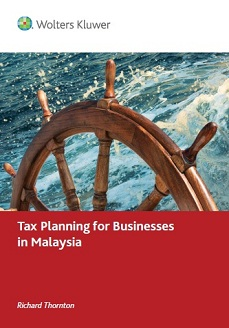
Tax Planning for Businesses in Malaysia
- Published: Jun 2016
- Book Code: 10076246-0001
- eBook Code: 10076247-0001
- ISBN: 9789670853192 (Book)
- ISBN: 9789670853215 (eBook)


Businesses in Malaysia have seen a steady tightening of the rules enforcing selfassessment such as the refusal of a tax deduction for an expense where information is not provided within the time allowed; and the denial of the right to appeal against a deemed assessment unless the taxpayer’s grievance is due to his deliberate non-compliance with a public ruling or a practice of the Inland Revenue Board generally prevailing at the time. Also, new laws are made every year and existing laws get reinterpreted through appeal decisions and rulings, presenting tax practitioners and advisers with a constant challenge to keep up to date. These and other significant changes are explained in this book.
More importantly, Tax Planning for Businesses in Malaysia aims to help you to plan strategically and skilfully in order to reduce the amount of tax paid by your company, and be prepared to solve any tax planning problem, whilst still keeping within the law. This book will explain how you can take advantage of government incentives and tax regulations to better position your company when tax season arrives.
Key features:
• “Tax planning tips” are provided at the end of every chapter. These are practical and easy-to-do tips that may just help you save on your taxes.
• Concise yet comprehensive commentaries, accompanied by numerous examples to illustrate concepts and enhance understanding.
• Appendices comprise tax rates for residents; income tax privileges and requirements for small companies; and reproductions of more relevant public rulings and tax frameworks that every business should be aware of. A brief Author’s Note is included before each public ruling and tax framework, explaining the importance and effect of the public ruling/tax framework.
Contents includes:
1. The Business Operator
2. Starting or Discontinuing a Business
3. Business Income
4. Special Kinds of Income or Receipt
5. Tax Deductions from Income
6. Incentives by Way of Double Deduction/Extra Deduction
7. Capital Allowances
8. Business Losses and Loss Relief
9. Tax Incentives by Way of Exemption of Income
10. Tax Compliance and Tax Payments
11. Withholding Tax
12. An Overview of Goods and Services Tax
Other titles you may be interested in...
-
Consolidated Financial Statements (10th Edition)
Consolidated Financial Statements,10th Edition was writte n to keep the materials up to date with the latest developments in financial reporting standards promulgated by the International Accounting Standards Board (IASB), as well as to incorporate changes in new IFRSs that may affect consolidate...
-
Veerinder on Malaysian Tax Theory And Practice 5th Edition
Veerinder on Malaysian Tax Theory and Practice (5th Edition) aims to serve as a recommended textbook for taxation courses offered by universities and professional bodies from the perspectives of content quality and production standards. With the aim to help taxation and accounting students in ...
-
Malaysia Income Tax Act , 9th Ed
Malaysia Income Tax Act 1967 – with complete Regulations and Rules is ideal for practitioners to use in the courtroom, handy as a desk or portable reference and reliable as a student text. This volume contains the full text of the Income Tax Act 1967. Rules and legislative notifi cati...
-
Malaysia Master Tax Guide 2020 - 37th Edition
The Malaysia Master Tax Guide 2020 is specifically designed as a reference guide to help tax professionals, accountants and taxpayers to fulfill their tax obligations for the 2019/2020 income year. It also provides information on the stamp duty, tax incentives, double taxation as well as the tax ...
-
Malaysia Income Tax Act 1967 with Complete Regulations and Rules (10th Edition)
Malaysia Income Tax Act 1967 – with Complete Regulations and Rules is appropriate for practitioners to use in court, practical as a desk or portable reference, and reliable as a student text. Income tax rules and legislative notifications have been reproduced or summarised in an easy-to-rea...


Prices shown are in MYR and do not include Delivery and Handling | Copyright © 2026 Wolters Kluwer